Michigan Senate Race Heats Up as Rivals Clash Over Muslim Brotherhood Allegations and Policy Stances
Candidates El-Sayed and Rogers engage in a fiery debate concerning alleged ties to the Muslim Brotherhood, alongside disagreements on foreign policy, healthcare, and the Michigan economy.
Media·
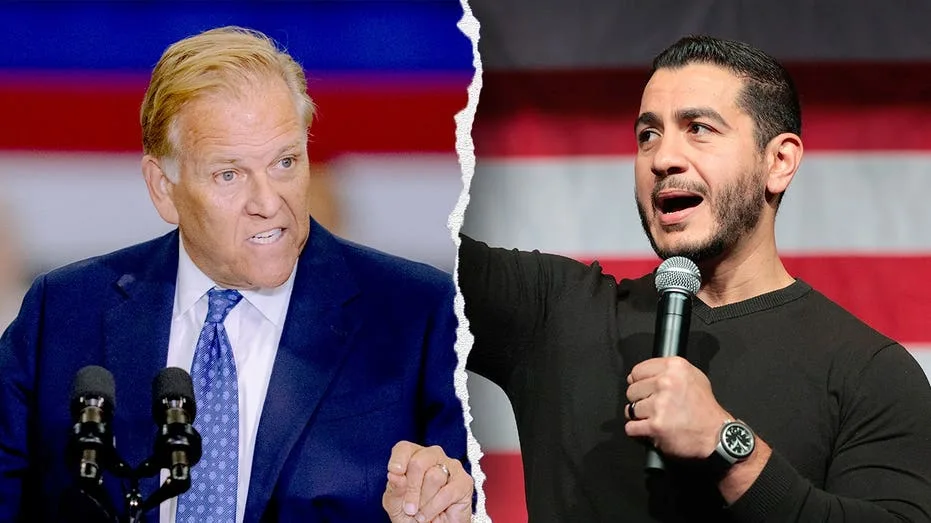
A contentious debate unfolded between Michigan Senate candidates, with accusations concerning alleged ties to the Muslim Brotherhood taking center stage. During an interview, the Republican challenger, El-Sayed, was pressed on a 2012 statement related to former Egyptian President Mohamed Morsi, who was associated with the Muslim Brotherhood.
“No, no, no, let me just stop there,” El-Sayed interjected, stating, “You are asking this question to raise a question about whether or not I have dual loyalties.” When the interviewer clarified the questions stemmed from allegations made by his opponent’s campaign, El-Sayed asserted, “I will be loyal to the Constitution of the United States.” He then urged the interviewer, “Don’t be Rogers’ campaign. Be a journalist.” The interviewer affirmed his role.
El-Sayed criticized his opponent for making his Muslim faith a campaign issue, describing the tactic as “sad” and “beneath him.”
Allegations and Denials Surrounding Muslim Brotherhood
The controversy partly revolves around a 2012 letter, previously reported by the Washington Free Beacon, which El-Sayed allegedly signed. This letter supported actions by then-Egyptian President Mohamed Morsi, including calls for a purge within Egypt’s police and media sectors. Additionally, El-Sayed has faced scrutiny over social media posts from his half-sister, which described their mother’s purported involvement in Muslim Brotherhood activism during the 1970s. El-Sayed has consistently denied any personal or familial connections to the organization, clarifying that he was raised by his father and stepmother.
In a separate interview, Rogers dismissed El-Sayed's characterization of the accusations. “I wore the uniform of the United States. Many in my family, including our son, wore the uniform of the United States so he can pray any way he wants,” Rogers stated. He clarified his concern was not about faith, adding, “It is not how he prays, it’s how he thinks.”
Rogers accused El-Sayed of embracing the organization’s ideology and portraying himself as a victim. “He has adopted the ideology of the Muslim Brotherhood,” Rogers alleged. When reminded that El-Sayed had denied membership and pledged allegiance to the U.S. Constitution, Rogers questioned, “Does he disavow? Does he really say it?” It was noted that El-Sayed had explicitly disavowed the organization during an October 17 town hall, responding with, “Sure. Yeah, absolutely” when asked directly.
Divisions on Foreign Policy and Economic Issues
The candidates also expressed differing views on several key policy matters, including the ongoing conflict with Iran. El-Sayed attributed rising gasoline and grocery prices to the war, asserting, “We need a war powers resolution to end the capacity for this president to wage an illegal, unjustifiable war.”
Rogers, while defending the initial justification for military action, noted he has urged President Donald Trump to conclude the conflict. “I’ve called for him to wrap it up. That’s the right thing to do,” Rogers commented.
Regarding Michigan’s economy, Rogers highlighted a loss of 27,000 manufacturing jobs in the state and pointed to some of the nation’s highest auto insurance costs. He also voiced concerns about education, claiming approximately two-thirds of fourth graders do not read at grade level.
Rogers defended President Trump’s influence in Michigan, citing his voter support and crediting his trade policies with encouraging General Motors to relocate Silverado pickup truck production back to the state. However, the Republican candidate acknowledged a disagreement with Trump regarding trade relations with Canada. “I’ve come out and said we shouldn’t be doing the Canadian tariffs the way we are doing them,” Rogers explained.
Healthcare and Campaign Strategy
The discussion also touched on healthcare, with El-Sayed being questioned about Medicare for All and its potential impact on middle-class taxes. “I’m fine with people keeping their private insurance if that’s what they want, but I want guaranteed public insurance for everybody,” El-Sayed stated.
Rogers countered El-Sayed’s position, arguing that Medicare for All would lead to the elimination of private insurance and increased costs for Michigan families.
Looking ahead to campaign events, El-Sayed promoted upcoming appearances with former President Barack Obama and Senator Bernie Sanders (I-Vt.). He also raised doubts about whether President Trump’s involvement would ultimately benefit Rogers’ campaign in Michigan.
Related Stories
NYC Mayor Mamdani Pressed on October 7 Statements, Combating Antisemitism Amid Community Fears
NYC Mayor Zohran Mamdani addressed intense questioning at a summit regarding his public statements on the October 7 attacks and efforts to combat antisemitism. He defended his universal approach to mourning and
Nov 19

Variety Suggests Hunter Schafer as Groundbreaking Bond Girl for Robert Pattinson's 007 Era
Entertainment magazine Variety has proposed transgender actress Hunter Schafer for a potential Bond girl role opposite Robert Pattinson's James Bond. The recommendation highlights the historic significance of such
Nov 18
Homeland Security Secretary Urges Calm Amid Technology Disruptions, Assures National Security
DHS Secretary Markwayne Mullin addressed recent widespread tech disruptions affecting banking and air travel. He assured Americans the homeland remains secure and that incidents appear unrelated, possibly stemming from
Nov 17
Pete Buttigieg Questions Democratic Student Loan Strategy, Citing 'Overtorqued' Approach
Former Transportation Secretary Pete Buttigieg recently stated the Democratic Party "overtorqued" the student loan issue. He finds it challenging to explain why non-college graduates should fund others' education,
Nov 16