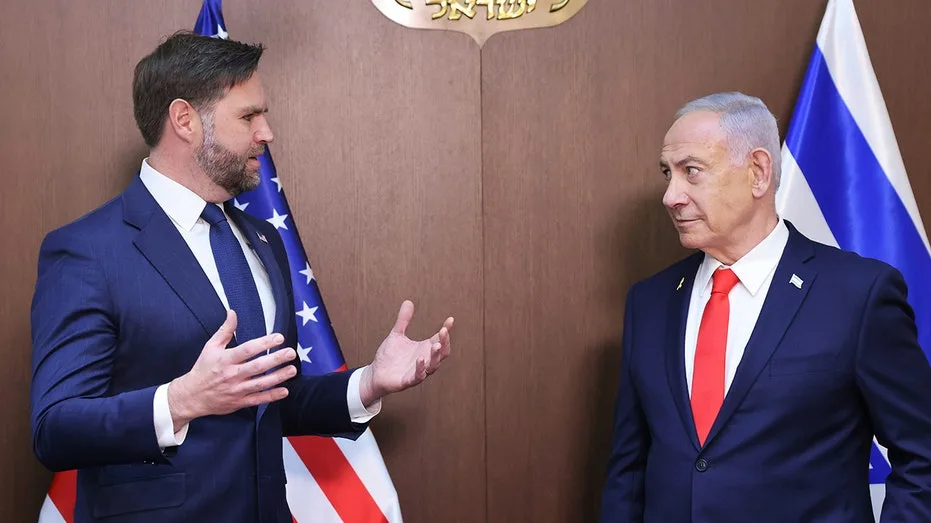
Vice President JD Vance reportedly voiced sharp disapproval of Israeli Prime Minister Benjamin Netanyahu's policies regarding the conflict with Iran, privately stating Netanyahu was "wrong on everything" concerning the war. These revelations underscore internal disagreements within the Trump administration and fuel speculation about Vance’s potential presidential campaign in 2028.
The reported clash, which surfaced on November 4, follows Republicans losing control of both congressional chambers in Tuesday's midterm elections. Vance publicly attributed the party’s defeat to the conflict, urging President Donald Trump to pursue a negotiated settlement rather than renewed military actions.
"The reason we lost is the war," Vance posted on X the day after the elections.
According to political analyst Sachs, this stance allows Vance to strategically distance himself from the Trump administration, which recently suffered a significant electoral setback. It also enables him to carve out a distinct position from President Trump himself, without directly criticizing the president.
Vance has reportedly led a group of senior administration officials advocating for Trump to negotiate an end to the conflict, cautioning that the unpopular war could cost Republicans their congressional majority.
Internal Discord Over Iran Strategy
In contrast, Prime Minister Netanyahu had urged President Trump to resume strikes against Iran before the midterms. However, Trump opted against it, despite having endorsed Netanyahu for reelection in Israel.
Sachs indicated that Vance’s primary concern appeared to be the prospect of overthrowing Iran’s government, particularly after Netanyahu presented Trump with a plan for regime change. Sachs noted that many opposition leaders in Israel are skeptical of achieving regime change through an air campaign, suggesting such an approach could have the opposite effect: "you may strengthen the regime."
The recent Israeli election further complicated the dynamics, Sachs explained, casting uncertainty over Netanyahu's political future and raising the possibility that Vance might need to engage with a different Israeli leader.
"If Netanyahu is not the leader of Israel, Vance will find himself with another decision to make: does he continue with a line that is confrontational with a new Israeli leadership, or does he say, 'Well, it was all Netanyahu; now we can see a different path forward'?" Sachs pondered.
Sachs added that Netanyahu serves as a convenient target for criticism due to genuine policy differences and his significant role in the conflict. This approach permits Vance to criticize the war and Netanyahu without speaking negatively about President Trump.
Political Implications and 2028 Aspirations
An AP Voter Poll revealed that approximately 6 in 10 voters considered U.S. military action against Iran to be the wrong decision.
"I think what's remarkable here is that it's coming out now," Sachs commented. "And it's part of the fact that about midnight Wednesday, the next presidential campaign in the United States began, and JD Vance is trying to position himself."
Sachs reiterated that Vance is diverging from President Trump's policy, but he is doing so by criticizing Netanyahu, not Trump.
Diplomatic Overtures and Future Prospects
Despite his position within the administration that initiated the conflict, Vance has played a prominent role in efforts to resolve the situation with Iran, including direct communication with high-ranking Iranian officials.
Last month, Vance dispatched a letter via Qatari intermediaries to Mohsen Rezaei, secretary of Iran's Supreme National Security Council, proposing a resumption of peace negotiations. The letter, according to reports, stipulated that any negotiations to avert further U.S. military strikes must address Iran's nuclear program. A U.S. official confirmed that Trump supported this outreach. Rezaei later acknowledged receipt of the letter but stated he had not yet responded.
"My suspicion is that J.D. Vance was operating on behalf of Trump on this," Sachs claimed. "Trump, after the war sort of settled after the first few weeks, appointed Vice President Vance to try and negotiate the exit strategy, and Vance has been very keen on that."
Sachs also pointed to Vance's involvement in an earlier memorandum of understanding (MOU) with Iran as further evidence of his preference for diplomatic solutions.
"He agreed to the MOU, which has become quite notorious in the United States, giving quite a bit to the Iranians, much more than the administration is now considering reasonable," Sachs noted. "Vance has certainly been on the side that has been trying to achieve a diplomatic breakthrough."
The White House is currently deliberating whether to resume significant strikes against Iran, maintain economic and naval pressure, or pursue a negotiated settlement. On Thursday, Reuters reported that Tehran submitted a formal nuclear proposal to the United States through Qatari intermediaries, making further negotiations contingent on Washington addressing its seven demands.
"The real question is whether the Americans and the Iranians can approach some kind of agreement on the fundamentals, starting with freedom of navigation in the Straits of Hormuz and the cessation of hostilities," Sachs concluded.
Navigating a Complex Political Landscape
For Vance, this ongoing dispute presents a delicate political balancing act: he must distance himself from a war he reportedly opposed, while simultaneously serving as vice president in the administration that launched it.
"He was against the war, so it would seem, but of course, he's vice president in the administration that went to war," Sachs observed, characterizing it as a "very difficult balancing act for him electorally."