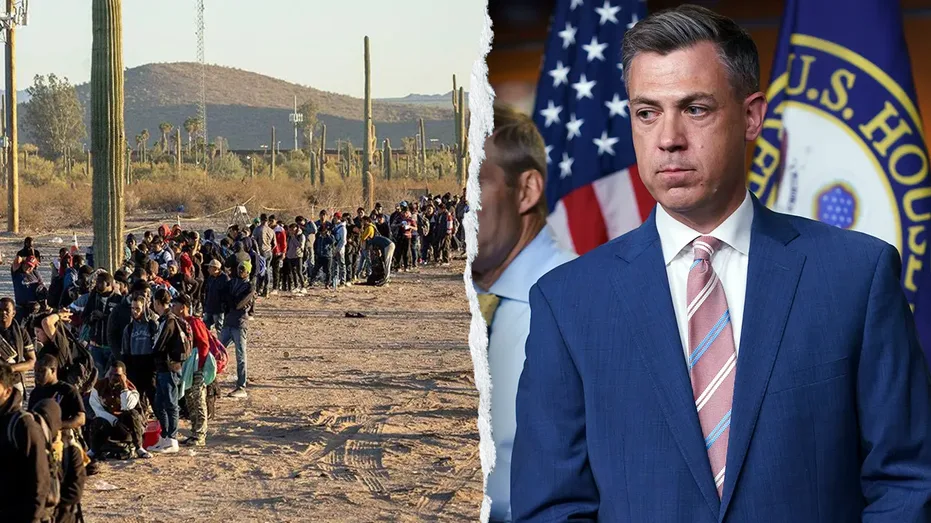
A significant five-day immigration enforcement operation conducted by U.S. Immigration and Customs Enforcement (ICE) across Indiana, which resulted in 426 arrests, is intensifying calls from Senator Jim Banks for Congress to legislatively secure former President Donald Trump’s stringent immigration policies. The aim is to prevent a future administration from altering these measures.
ICE officials noted the crucial collaboration with state and local law enforcement agencies during the operation, a factor Republicans frequently highlight as essential for effective immigration enforcement.
However, Senator Banks contended that while the operation demonstrated robust enforcement, it also exposed a fundamental vulnerability of executive-driven initiatives: current aggressive measures do not guarantee the continuity of these immigration policies under subsequent administrations.
"It is important that we codify Trump border security measures and tough-on-immigration policies and make them the law of the land," Senator Banks stated.
He further remarked, "If this could happen in Indiana, it could happen anywhere," asserting that opposition efforts have complicated the achievement of immigration objectives, particularly by removing ICE from the 2025 immigration appropriations legislation.
"They've made that one of their biggest priorities in this Congress to defund our federal law enforcement, to stop ICE from doing their job, to deport violent criminals who are here illegally," he elaborated.
"So it is important that we codify Trump border security measures and tough-on-immigration policies and make them the law of the land so that the next time, God forbid, a Joe Biden ever gets elected back to the White House or someone that comes from that radical wing of the Democrat Party…" Banks continued, underscoring the urgency of legislative action.
The Push for Permanent Immigration Policy
Senator Banks also expressed dissatisfaction with his own party, criticizing the Republican-controlled Senate for its failure to advance separate election-related legislation, which he views as another critical priority.
Numerous conservative voices have advocated for the passage of the SAVE Act, a proposed bill that would mandate documentary evidence of U.S. citizenship for voter registration in federal elections.
"That’s one of my biggest disappointments with this Republican Senate – we haven’t passed [it]," he remarked concerning the bill.
"I hope by the end of the year that we can find a way to pass it. I'm going to keep fighting for it, but at the end of the day, the Trump administration and the Department of Justice is doing a lot crack down on illegals voting in our elections."
Concerns Over Voter Integrity
In a distinct case within Indiana, the Department of Homeland Security (DHS) apprehended an individual on September 18 who had reportedly entered the U.S. without authorization during the Obama administration and subsequently cast a federal ballot.
Patricia Hyde, Assistant Director of the ICE Enforcement Division, emphasized that the right to vote is the "cornerstone of democracy" when announcing the arrest of Guatemalan national Helda Mendez-Merida, citing her alleged actions as "poisoning our elections."
"We cannot allow that sacred right [to vote] to be perverted," Hyde stated.
Senator Banks contended that such incidents continue to emerge "because Joe Biden and Democrats flooded our country with tens of millions of illegals – they’re still here [and] mass deportation is important."
Legislative Challenges in the Senate
Senate Majority Leader John Thune, a Republican from South Dakota, has consistently countered criticisms suggesting he has not sufficiently endeavored to pass the SAVE Act or further the agenda of former President Trump.
"I keep asking the question, am I the only one in this town that can count to 50? Because it seems like these questions recur and there are a lot of people out there who haven't seemed to internalize the fact that there aren't Democrats that are going to flip and vote for this," Senator Thune explained, referring to the legislative realities in the Senate.