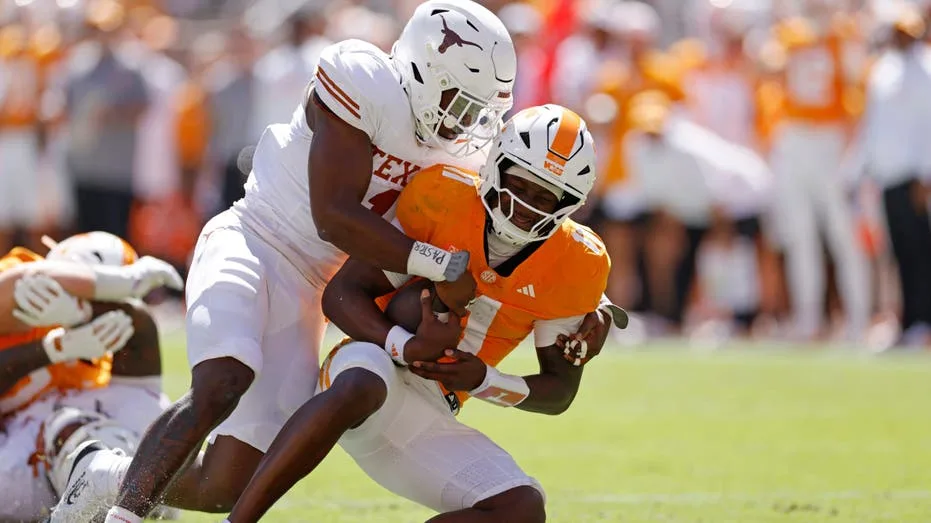
Texas Longhorns defensive end Colin Simmons has garnered significant attention for his on-field prowess, often appearing to dominate opponents with his strength and skill. However, a recent incident during the team's victory over Tennessee has drawn scrutiny, shifting focus from his athletic achievements to questions about his maturity and public conduct.
Simmons, who has openly identified as a Christian, previously gained recognition for a moment of profound faith after winning the Texas 6A Division I state championship with Duncanville High School. At that time, he brought a Bible onto the field and declared, "It ain't nobody but God!", attributing his success to a higher power and deflecting personal glory. This past display of faith stands in stark contrast to his recent actions.
Following a crucial third-down sack deep in Tennessee territory, Simmons engaged in a celebration that simulated pulling out his penis and urinating on the field. This gesture was widely condemned as not only immature but also deeply offensive. During the game broadcast, commentator Kirk Herbstreit described the act as "idiotic," while Chris Fowler noted that "it doesn't much [more] vulgar" than what Simmons displayed.
Public Scrutiny and Faith
The incident has opened a broader conversation about the responsibilities of athletes in the public eye, particularly those who profess religious beliefs. For Simmons, who represents not just the Longhorns but also, in the eyes of many, his Christian faith, his actions are seen as a reflection on that faith. While Christian beliefs are not defined by the moral shortcomings of individuals, the words and deeds of professing believers are often viewed as indicators of their convictions. This perspective suggests that Simmons' actions carry additional weight due to his public statements of faith. The argument is made that individuals who identify as Christian are held to elevated moral and ethical standards.
This sentiment was also observed in another recent event involving Ole Miss player Trinidad Chambliss. After an upset victory against LSU, Chambliss used an expletive in a postgame interview, despite having praised God extensively during the same interview. This was seen as an inconsistency and a lack of self-control. Chambliss later issued an apology, expressing remorse for his words and stating, "That’s not who I am. I’m deeply, deeply apologetic to Holly Rowe & everyone who was listening." He was notably wearing a "Jesus Won" T-shirt during his apology, underscoring his regret for misrepresenting his faith.
Houston Texans quarterback CJ Stroud also addressed the issue of profanity among Christians in a 2024 interview with Sports Spectrum. Stroud emphasized, "I can't proclaim I love God and have a wild mouth… it's hypocritical." He referenced James 3, a biblical passage that discusses the importance of controlling one's speech.
Addressing the Apology and Accountability
The nature of Simmons' celebration, described as a "premeditated sack celebration with that level of vulgarity," is viewed by some as particularly troubling for a professing Christian athlete, distinguishing it from spontaneous outbursts of frustration or anger.
Simmons did offer an apology after the game, but its sincerity has been questioned. He reportedly attributed his actions to being "in that mode, feeling myself. It happens." Critics argue that such a statement diminishes the severity of the act and suggests a lack of understanding regarding the implications of his suggestive behavior, especially given his Christian identity. While minor lapses like cussing or losing patience might "happen," simulating urination on a field is described as a deliberate, unsportsmanlike, and vulgar act.
The Bible, specifically 1 Peter 4, encourages early Christians, and by extension believers today, to uphold a higher standard of conduct than they did before their conversion. This passage calls for the pursuit of holiness and mutual encouragement in that pursuit.
The author of the original piece extended this call to Simmons, urging him and his Christian associates—teammates, family, and coaches—to provide accountability. Drawing from Proverbs 17:7, "As iron sharpens iron, so one person sharpens another," the message stresses the importance of community support in maintaining one's spiritual path, especially when influenced by factors like money, status, and fame.
Reflecting on Public Faith
Christians are understood to operate within a moral framework, and while perfection is not expected, they are often held accountable for perceived hypocrisy. The inherent understanding of right and wrong, present in all humans, underscores that actions like Simmons' are fundamentally inappropriate for a football setting.
Following the game, Simmons posted on social media, writing: "All Glory To God 🙏🏾 Thank you for listening to my prayers and forgive me for my actions."
The author of the original article responded directly to Simmons' tweet, stating:
"This is a great learning experience, Colin. You have a lot of eye balls on you. Please use the platform & abilities God has given to be a good representation of Him. Don’t be like the world. Live like a man renewed through Christ. Thank God for His grace & forgiveness."
This incident serves as a broader reminder for all Christians, not solely those with public platforms. Individuals are often under scrutiny, with both peers and younger generations observing their actions. As referenced by CJ Stroud and in James 3, there's an expectation that the tongue used to praise God should not also be used for vulgarity. Ultimately, the message emphasizes living a moral life consistent with one's faith, not merely to appease others, but in devotion to one's professed Lord and Savior.