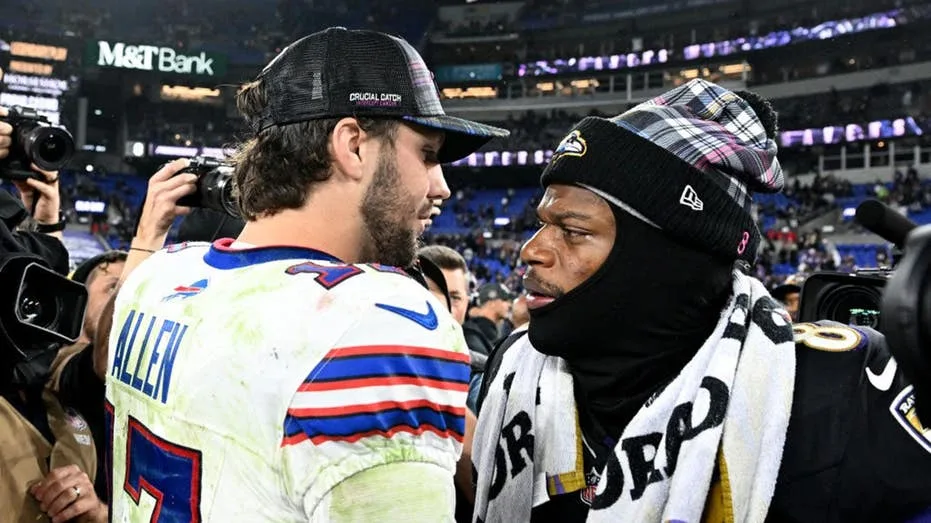
Following Caitlin Clark's exit from the WNBA playoffs, sports media attention has naturally shifted, with Buffalo Bills quarterback Josh Allen becoming a central figure in recent discussions.
Bomani Jones, a former ESPN personality, has actively sought to revitalize his media presence by fostering a perceived racial divide between supporters of Allen and Lamar Jackson. Last month, Jones alleged that unnamed "white folks" favored Allen, despite his own stated preference for Black quarterbacks on multiple occasions.
It is worth noting that there is no substantiated evidence to suggest a widespread preference among white individuals for Allen over Jackson. Consequently, Jones has not identified these supposedly biased individuals.
Nonetheless, observing his persistent efforts to frame the Allen vs. Jackson dynamic as a significant rivalry is notable. His established brand often dictates alignment with the Black athlete, irrespective of the facts, frequently leading to the application of inconsistent standards to justify his stance.
A clear illustration of this pattern emerged in his coverage of their respective game-losing interceptions this season.
Disparate Reactions to Key Interceptions
Earlier this week, Jones released a YouTube segment titled "Josh Allen Is Still THAT Guy…" in which he openly disparaged Allen. During his commentary, Jones labeled Allen a "moron" and implied that the Bills' strategy of tolerating his occasional rash decision-making was misguided.
"Look, [the Bills] cast their lot on the idea that we're just gonna live with Josh Allen and whatever he does, but that's not – I don't think that's what they're talking about. Like the idea isn't and every now and then be a moron," Jones stated.
He proceeded to mock the notion of Allen being an MVP frontrunner or considered the league's top quarterback.
"They still called him an MVP. We still talk that. Remember how ready everybody was to make him the best quarterback in the league and everything else. Are they still saying that now? I'm asking that."
Contrast this with Jones's response two weeks prior when Jackson threw a similar interception in a last-second defeat against the Saints.
Jones acknowledged Jackson's recurring late-game struggles, even under a new coaching staff, but promptly softened his critique by affirming that Jackson "is a sure-fire Hall of Famer and all of that."
He then introduced an alternative explanation for the play: the receiver.
"I will say I felt like the way that Rashard Bateman reacted at that interception, it looked like he was the one that made the wrong move," Jones added.
Ultimately, Jones underscored that despite Jackson's late-game difficulties, "he looked awesome, awesome for three quarters."
In summary: Jackson's interception was costly, yet potentially not his fault. He remains a Hall of Famer, performed excellently for the majority of the game, and his receiver might bear the blame. Allen, however, was simply a "moron" for a similar error.
Notably absent was any sarcastic questioning of Jackson's standing among the NFL's elite quarterbacks, a designation Jones and his guests frequently bestow upon him. This subtle disparity in treatment has been observed before.
This pattern was initially identified in 2023, when both Allen and Jackson suffered home losses in consecutive weeks to the eventual Super Bowl champion Kansas City Chiefs. Jackson's performance against the same defense was considerably weaker than Allen's, and he also threw another game-losing interception. Despite this, Jones directed significantly more criticism toward Allen.
The Media's Framed Rivalry vs. On-Field Reality
Allen and Jackson are often linked by certain commentators for straightforward reasons. They were drafted in the same year and have largely spent their careers vying with Patrick Mahomes.
Allen, a white quarterback from a rural background, faced past scrutiny for inappropriate teenage tweets. Jackson, a Black quarterback, was reportedly overlooked by at least one anonymous scout and, according to Jemele Hill, embodies a connection to his "people" akin to Allen Iverson.
It is important to clarify that Jackson himself has never centered his career around his race. This role has been attributed to him by segments of the sports media, with Bomani Jones being among those who perpetuate it.
These commentators appear to desire a rivalry between the perceived Big Bad White Quarterback and the Disrespected Black Quarterback. While an inherently simplistic framework, they remain committed to it.
Prior to the current season, Jones asserted that the media subjected Jackson to a more rigorous standard than Allen, despite substantial evidence suggesting the contrary.
Furthermore, proponents of this narrative—including Jones, Ryan Clark, and Cam Newton—inadvertently diminish Jackson when they insist on comparing him to Allen. At this juncture in their careers, the two quarterbacks are not considered to be on comparable levels of performance.
Allen is widely regarded as significantly superior.
This assessment is not merely anecdotal; it is echoed by those professionally tasked with evaluating NFL quarterbacks.
In August, The Athletic surveyed 50 NFL executives and coaches to rank the league's quarterbacks for the upcoming season. Allen was placed at No. 2 in Tier 1, behind Patrick Mahomes and ahead of Matthew Stafford and Joe Burrow. Jackson, meanwhile, ranked No. 5, falling into Tier 2.
A month earlier, ESPN conducted a similar poll among league executives, coaches, and scouts. That collective ranked Allen as the best quarterback in football, with Jackson again finishing fifth, a full tier below.
The question then arises: whose judgment should hold more weight—NFL coaches, executives, and scouts, or Bomani Jones, Cam Newton, and Ryan Clark?
One group dedicates its profession to analyzing film, personnel, and on-field performance. The other increasingly filters sports discourse through racial narratives and the social media reactions these narratives provoke.
Comparative Playoff Performance
The disparity in their postseason achievements is even more pronounced:
- Josh Allen: 38 total touchdowns, 4,682 total yards, six interceptions, a 101.4 passer rating, and an 8-7 playoff record.
- Lamar Jackson: 13 total touchdowns, 2,394 total yards, seven interceptions, an 84.6 passer rating, and a 3-5 playoff record.
Labeling Allen a "moron" while offering nuanced context for Jackson's errors may garner attention within certain cultural debates, but it does not establish a genuine rivalry between the two athletes.
It mirrors the media-driven comparison between Caitlin Clark and Angel Reese: a rivalry largely sustained by those who wish the competitive gap were narrower than the evidence indicates.
If commentators like Bomani Jones are intent on pitting a White athlete against a Black athlete, it would be more appropriate to select two individuals performing at a roughly equivalent level.
As a side note, Jones also attempted to construct a rivalry between Kyler Murray and Sam Darnold last summer, after Darnold's Super Bowl victory. Unsurprisingly, Jones supported Murray, the Black quarterback. That particular comparison has not held up well over time either.
This highlights a fundamental issue when racial identity supplants objective analysis: ultimately, the outcomes of the games speak for themselves.
A straightforward conclusion, devoid of any racial sociological interpretation, is readily available: both Josh Allen and Lamar Jackson made errant throws that proved costly for their respective teams during the initial month of the regular season.
Not every moment in sports needs to fuel broader cultural conflicts. Sometimes, a poor interception is simply a poor interception.